

From the New York Times, January 28, 2009
And in Florida, not far from the Palm Beach clubs where Mr. Madoff wooed some of his investors, George L. Theodule, a Haitian immigrant and professed “man of God,” promised churchgoers in a Haitian-American community that he could double their money within 90 days.
He accepted only cash, and despite the too-good-to-be-true sales pitch, he found plenty of investors willing to turn over tens of thousands of dollars.
“The offices were beautiful, and I was told it was a limited liability corporation,” said Reggie Roseme, a deliveryman in Wellington, Fla., who lost his entire savings of $35,000 and now faces foreclosure on his home.
This brings to mind the question of authenticity. Ponzi schemes, shams that we can believe in, until the truth comes out, prey on our desires and weaknesses. Our willingness to rely on appearances for signs of authenticity (The offices were beautiful) points to questions about architecture’s role in such deceptions.
It’s been said that “Art is a lie that tells the truth” . The history of architecture, reflects an ambivalence about “truth”. Architecture operates like language, representing but not necessarily embodying, and architecture is a constructed embodied, materialized phenomenon that is primarily experienced. We read and experience architecture simultaneously. Geometry, space, materials, tectonics order form, form an order which we would hope is revelatory, engaging and celebrating our humanity , rather than deceitful, obscuring and controlling.
The predominance of vision has effected the way we think about materials. As more and more communities employ “stampcrete” and if they can’t afford that, “stamphalt” in public spaces, the erosion of values is painfully obvious. The attitude of “as long as that stuff looks like brick, it’s OK” is exactly what got the ponzi scheme victims into trouble. Actually all the use of fake materials is sort of like a ponzi scheme–you simply put the day of reckoning off until the whole thing fails and at great expense you end up doing what you should have done the first time around. Materials carry memory, and the replacement of materials with facsimiles destroys memory, with it the hard won truths and values of our society. As an example I’ve posted two images of bricks one of painted stamped asphalt and the other of 19th century brick pavers.

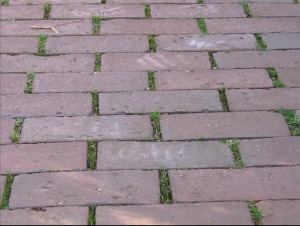
The inadvertent marks of the makers, of the hands that handled the wet clay can be seen in the lower image, the memory of the lives that made these bricks. The moss growing between each brick reveals an unanticipated symbiosis of inert and living matter. the bricks, slightly uneven gently accommodate the pushing of tree roots below without cracking or failing. The stamphalt has none of this capacity to hold time and life–no capacity for memory and for that matter, imagination. The fact that it is unsustainable and unrecyclable is no coincidence. Whenever we remove the dimension of time and the capacity to remember from materials, we fall prey to appearances and hidden costs, not only economic and environmental but cultural and societal.
Recent Comments