3six0 Wins Four AIA/RI Awards

December 29th, 2009 § Nick

AIA RI_AWARDS_WEB

On December 10, the Rhode Island chapter of the American Institute of Architects held its annual awards ceremony at the Narragansett Towers in southern Rhode Island. This year we submitted East Side Addition (Residential), Old Stone House Inn (Adaptive Reuse), Old Stone House Spa and Restaurant (Interior), and Au Bon Pain (Commercial/Industrial) –all four received Merit Awards in their respective categories. Take a look at our submissions and view other winners on AIA/RI’s website.

Leave a reply

Amazing PoP!tech

October 26th, 2009 § kynaleski

I had the incredible experience of Pop!tech this past week. The theme was “America Reimagined” and some of the luminaries who spoke were: Dan Ariely, Will Allen, George Church, John Fettermn, Daniel Goleman, Tony Hey,Daniel Nocera, Gideon Obarzanek,Dean Ornish, Katy Payne, Michael Pollen, Reihan Salam, Paul van Zyl, Luis von Ahn, Michael Wesch….

It blew my mind.

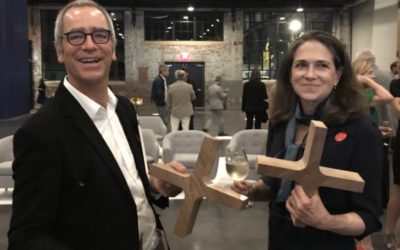
Kyna Leski at Pop!tech 2009, photo by Kris Krüg

Kyna Leski at Pop!tech 2009,
photo by Kris Krüg

I also got the opportunity to make a presentation, that I call, “Cohering Entropy: Navigating the Creative Process.” You can read my entire lecture notes here. Some notes from parts of my talk:

A strange thing happened about 20 years ago, very early on in my career as a teacher. I gave a group of students this painting by Paul Klee, called Polyphonically Enclosed White, and I asked them to build the third dimension using only white glue and white museum board.

Klee3

One of the students, John Schroeder, decided that he would assign different heights to each colored rectangle. He couldn’t tell me why he was doing this…but there was something about his sense of purpose that made me step aside and watch. He worked through the night and built this object and when he was done he held it up to the indirect sunlight coming from the north side of the building.
This is what he saw. He had somehow osmotically channeled the work of Paul Klee.

I am showing you this, not to mystify things… in fact….there is a good explanation of why the light is refracted in this way given the differing sizes and heights of this cluster of tubes. But there isn’t an easy explanation of how John arrived at this idea. This is what interests me: how we get there…or how we navigate the creative process.

I have been surprised and awed by the imagination many times since then. It has made me think I am an atheist and believe I am not. This dilemma draws me into the creative process in my teaching and my work.

How an artist gets to a discovery or invention is mystified in our culture…it’s outside the umbrella of words like “talent” or “genius.” These words keep us from seeing what is at work and keeps it in the periphery and not to be depended upon. I like to call talent or creative abilities, intelligences. One of the most important intelligences for an artist is sensibility. “Sensibility”—keen intellectual perception—not the optics of the eye or capacity of the sensory organs—but how we take this information and form a concept of the world and our place it. Sensibility is on the cusp between percept and concept…which is at the heart of intelligence.

. . .

Search engines gather for us. The founders of Google, stated that “if you had all the world’s information directly attached to your brain, you’d be better off.” And that he and his partner’s ambition for “perfect search engine” would be one that could understand exactly what you mean and gives you back exactly what you want.”

My ambition is the opposite: Creativity….is not in knowledge but in the way towards knowing. Discovery is about arriving somewhere other than where you wanted or expected. And invention is moving outside of what is known.

. . .

Dwelling in uncertainty is key to growth and moving beyond the known through the imagination.

Creative, process are two words neither of which are creative and both are more processed than process.I think of it as cohering entropy. A creative work makes its own necessity by cohering what wasn’t before and now we don’t want undone. Cohering by recognizing connections from the astronomical to the metabolic, by putting together what precedes, follows and is next to: coherence gathered, and meaning made.

Leave a reply

The Animated Biltmore

October 13th, 2009 § Nick

A new video of the Biltmore Hotel Porte Cochère project has been posted on 3six0’s YouTube channel. The evolution of the project is condensed into a 30 second animation that illustrates material reasoning driven by the net-like matrix of the hotel’s lobby ceiling, and the canopy’s function as a sheltering entry-marker that reverberates with the historic architecture of the Biltmore Hotel and the city of Providence.

Leave a reply

September 16th, 2009 § Olga

Glass Factory

On July 2009 Kolbe and Kolbe Window Manufactory invited our office to Wisconsin. They were not only so kind as to take us to their factory, but also schedule a number of interesting events for our brief visit. Among these were:  a tour of Frank Lloyd Wright’s Taliesin, a visit to Aldo Leopold Foundation Headquarters (the first LEED-platinum certified building) and the Cardinal floating glass factory.

These pictures of the glass factory capture some moments along its assembly line:  A mound of sand and cullets waiting to be fed to the furnace, its transformation to molding glass and its division into panels to name a few.

This assembly line has been running continuously for 12 years and for its optimized performance this continuity has not been broken.  All the glass produced in this factory has been cut from a single stretched sheet of glass. One of the processes that particularly called my attention along this trajectory was the moment in which the glass is cut. The mechanisms of this machinery respond to the seemingly simple necessity of cutting straight edge panels from a moving ribbon.

After being transformed into molding glass, a long tongue of glass stretches out from the furnace. This hot taffy-like material is carried on a conveyor by rubber wheels. As this continuity is to be maintained, to achieve a right angle panel the blade is set at a particular angle to accommodate the speed at which the glass travels. In other words, to achieve a rectangular panel the blade cuts the moving glass at a diagonal.

Interesting facts from our guide: Glass is never in a true solid state.  The inert medium in which the glass is suspended is liquid nitrogen. As mentioned before, the furnace has not been shut down in 12 years making its maintenance cumbersome as the molding glass is frozen in order to repair the damaged sections.

Leave a reply

3six0 participates in the Met School mentoring program

July 29th, 2009 § Jack

Over the past two years 3six0 Architecture has been participating in the mentor program of Providence’s Met school. The Met School, short for Metropolitan Regional Career and Technical Center, is a state-funded school district that serves 690 high school students. The school was created under the direction of Doctors Dennis Littky and Elliot Washor who were given the opportunity by the state of RI to create a “school of the 21st century” that would involve “hands and minds.” The Met is divided into six smaller schools, with four of them sharing a campus on Providence’s South Side.  The schools are intentionally kept small at 120 students and the curriculum focuses on “Authentic Experiences”.
 
“Education research tells us schools need to be smaller, with more parent involvement and more personalized curricula. Brain Research shows people learn by making sense of information, by connecting things, and learning by real context. Learning theory asserts the value of hands-on experiences. Development psychology says kids are fragile and must be nurtured by adult mentors to thrive. Gang research tells young people need to feel a part of a culture, something larger than themselves. The Met incorporated all of these notions and opened its doors in the fall of 1996 with 50 freshman in the Shepherd Building in downtown Providence.”      The Met School
 
Alejandra Vidal, Met school junior, interned at our office this past January to June. Brandee Lapisky, her Met advisor, introduced Alejandra to us when she expressed a desire to learn about green architecture practices. Alejandra and I decided to divide her internship into two parts, with the first part focusing on research into passive methods of heating, cooling and shading used in the design of structures to create comfortable environments and reduced dependence on energy. The second portion of the internship would be her own design proposal involving both a real client and a project that would be ultimately constructed.

Jack Ryan and Alejandra Vidal at 3six0 office (center photo)

Jack Ryan and Alejandra Vidal at 3six0 office (center photo)

The mentoring experience has proved to be a rewarding experience for both Alejandra and 3six0. 
 
To learn more about the Met school or about becoming a mentor, visit:  www.themetschool.org

Leave a reply

Presence & Absence: Carlo Scarpa, Querini Stampalia, & Water

July 23rd, 2009 § Rob

Where is ground level after all, where is terra firma? Hard to tell. Instead there is a strange sensation of hovering in a zone of water and sky as the earth drifts somewhere in the mix.  – Michael Cadwell

[all references and images are taken from Cadwell, Michael.  Strange Details.  Cambridge, MA: The MIT Press, 2007.]

The Querini Stampalia Foundation by Carlo Scarpa is a powerful reminder of architecture’s capacity to embody particular qualities without necessarily being literal.  Querini Stampalia was originally a family palace built in Venice during the 16th that was converted into a small foundation devoted to “promote study of useful disciplines and nation and foreign knowledge” (12).  After a series of damaging floods in the early 1900’s, Carlo Scarpa was commissioned to renovate the ground floor in anticipation of future flooding.

exterior of the Querini Stampalia Foundation

exterior of the Querini Stampalia Foundation

What’s exiting in this work is Scarpa’s understanding of water as an unsettling force – as a medium caught between the solidity of the earth and the volatility of the sky.  Water is at once dependable and volatile – it is present like the earth, but in constant flux like the sky.  And as Cadwell points out, Venice embodies this precariousness.  “In Venice, buildings do not spring from the earth – they tether themselves to the mud below, or they hover above it” (8-9).  This aquatic quality, this precariousness, pervades Querini Stampalia through details that unsettle and keep us on edge.

Ground Floor Plan

ground floor plan

For instance, the main entrance to Querini Stampalia is a small footbridge leading from the adjacent campiello directly into the ground floor foyer.  Seemingly simple, the bridge is slightly eccentric so that the entrance to Querini Stampalia lies slightly below the campiello.  So even before entering the building, Scarpa calls into question the solidity of the ground that is so precarious in Venice.  The bridge drops us below the established ground line and brings us closer to the water below.

entrance bridge

entrance bridge

Inside the main gallery, we find a similar articulation of conflicting levels and an unsettling ambiguity regarding the location of water and ground.  First, the gallery steps down from the entrance foyer, bringing the floor even further below the ground line outside.  There are three columns in the space, but none of them align to establish a firm ground line.  Finally, the floor is detailed for floods and wraps up the sides of the wall to define a waterline.  Without being explicit, Scarpa places the visitor somewhere beneath the water, but where exactly is unclear. “So we are up to our ankles.  The grass outside [in the courtyard] is above this line, but no matter, the water rises to our shins” (25).  These waterlines all undermine any sense of a solid ground, but instead locate the room somewhere between the ebb of the tide.  And though the gallery anticipates water and its presence can be felt throughout, the most unsettling part is the lack water and the lack of any reference to establish where that waterline actually lies.  The gallery gives hints and suggests possibilities but provides no assurance.  Instead it lies somewhere in the middle.  Water is absent, but its presence is felt throughout.

Main Gallery Looking Towards Garden

Main Gallery Looking Towards Garden

conflicting levels within the gallery

conflicting levels within the gallery

Leave a reply

Stone House Club: Spa and Restaurant

June 3rd, 2009 § Olga

barn_construction-pictures

3six0 was commissioned to restore and renovate the much loved but well worn Stone House Inn in Little Compton, Rhode Island into an authentic destination hotel. The renovated project is comprised of 12 hotel units, two restaurants and a spa.
The original Stone House was constructed in 1854 as a private residence in an Italianate style but soon after was converted into an inn.
3six0’s challenge has been to balance the preservation of the historic Inn with the client’s modern needs. The team’s approach has been to integrate green building technologies wherever possible with the implementation of its restoration and its contemporary use.
The project is currently under construction. Here are some before and in-progress photos of the construction of the “Barn”: Spa and Restaurant …

Leave a reply

Virtually there

May 29th, 2009 § Chris

A decade ago , the dream of virtual space  was about to be realized, or so it seemed. Videoconferencing promised to eliminate the need for travel; the “glove” and VR  glasses were ubiquitous features at malls as were  elaborate 3D simulation pods. I remember architecture students at the time speculating about the end of architecture–who needs  spaces for conferences,meetings, social interaction when all that can be done virtually. Oddly enough as the web has grown , virtual reality has become less about hardware and  more about software ie  social media 2.0. Seems virtual reality is getting more virtual. One major exception is the military use of  virtual reality to wage combat at a distance.

Unexpected consequences are emerging :

On its face, it seems like the less stressful assignment. Instead of being deployed to Afghanistan or Iraq, some pilots and other crew members of the U.S. military’s unmanned Predator drones live at home in suburban Las Vegas and commute to a nearby Air Force base to serve for part of the day. They don’t perform takeoffs and landings, which are handled overseas. But the Predator crews at Nellis Air Force Base in Nevada “are at least as fatigued as crews deployed to Iraq,” if not more so, according to a series of reports by Air Force Lt. Col. Anthony P. Tvaryanas. The [reports] also showed that Predator crews were suffering through “impaired domestic relationships.”

Why is this? Part of the problem lies in what Tvaryanas calls the “sensory isolation” of pilots in Nevada flying drones 7,500 miles away. Although there are cameras mounted on the planes, remote pilots do not receive the kind of cues from their sense of touch and place that pilots who are actually in their planes get automatically. That makes flying drones physically confusing and mentally exhausting. Perhaps this helps explain the results of another study Tvaryanas published with a colleague in May, which examined 95 Predator “mishaps and safety incidents” reported to the Air Force over an eight-year period. Fifty-seven percent of crew-member-related mishaps were, they write, “consistent with situation awareness errors associated with perception of the environment” — meaning that it’s hard to grasp your environment when you’re not actually in it.

Aaron Retica  New York Times December 14, 2008

Although these studies were limited, it does conform to our sense that seeing is not being. By working with concepts, plans, sections  and other instruments, Architects are constantly looking at the third dimension as an equivalent of the other two. We move around, through designs, we make models, hold materials in our hands, look at architecture spatially. This effort to “be” in the world to inhabit “the flesh of the world” as Merleau-Ponty famously wrote about the third dimension,  joins the haptic with  the visual, or so we hope.

Over the past decade the explosion of design publications, print and digital, and the advances in 3D rendering have placed a premium on the image. One hallmark of our times is architecture as a spectacle; if it looks spectacular it will get press, regarless of it’s virtues or weaknesses. This creeping emphasis on the visual brings us back to the virtual. If pilots are losing their minds because of the loss of the environment and architecture is reduced to image–at least in publications, shouldn’t we give pause to how we consume and produce architecture.

It’s interesting that computer models, as wonderful a tool as they are, do not replace physical models. Could the touch, texture, light qualities and spatial nuance of physical models be what allows us to “grasp the environment’ in a way those pilots can’t? And as abstract as a plan or section is could it be that at a fundamental level these kinds of drawings allow  metrics and order of the environment to be cognated, something the drone pilots were missing.

Image by sklathill

Are physical models still valuable as architectural tools?

View Results

Loading ... Loading ...

Leave a reply

STIX and CIRCA in SPA-DE

May 18th, 2009 § Nick

spa-de
STIX and CIRCA have both been published in the current issue of SPA-DE (Space and Design Vol.11) as part of the magazine’s “International Review of Interior Design” issue. The inclusion of these projects in SPA-DE, a Japanese publication, follows our recent features in the Korean magazine, PLUS Architecture and Interior Design. (February #262 / May #265)

Leave a reply

Shepherd of the Valley Chapel

May 13th, 2009 § Olga

horner_360_08147_012

The Shepherd of the Valley Chapel was featured in PLUS Architecture and Interior Design magazine 2009 05.

http://www.pluszine.co.kr/main.php

Leave a reply

Bad Behavior has blocked 171 access attempts in the last 7 days.